05.06.2026
Date
54
Views
0
reviews
#214118
ID
Characteristics
- Chastota
- 50 Gts
- Erkin aylanish tezligi
- 3100 ob/min
- Kuchlanish
- 220 V
- Patron diametri
- 10 mm
- Patron turi
- tez qisish
- Quvvati
- 470 Vt
Description
A drill is a manual, pneumatic or electric tool designed to impart rotational motion to a drill or other cutting tool for drilling holes in various materials during construction, finishing, carpentry, plumbing and other work. Most often the drill has two modes of operation: normal and with impact. The normal mode is designed for carpentry and locksmith work. The impact drilling mode is designed for drilling holes in stone, brickwork or concrete. In the impact mode, the drill performs not only rotational, but also reciprocating motion, which allows drilling solid walls in a short period of time. The longitudinal movements of the drill are provided by the impact mechanism of the drill. For drilling stone (brick, concrete), a nozzle or drill bit with a special tip of increased hardness is required. The impact drill differs significantly in its effectiveness from the hammer drill, and it should not be considered as a full-fledged replacement for the latter. Drilling with impact is unacceptable in cases where there is a risk of cracking of the material, for example, when drilling ceramic tiles and tiles or in close proximity to the edges of walls. In addition to drilling, the drill can be used for turning/unscrewing screws and screws. In addition, nozzles for grinding and cutting are common, designed to be fixed in the drill chuck. You should work with the tool carefully. When carrying out any work with a drill, it is necessary to wear protective glasses to avoid getting small particles of the processed material into the eyes.
403 000 so'm
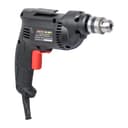
Дрель EPA EED-10M-9
EquipmentFor saleQuantity: 1Right-angle drill
Contact phone
Characteristics
- Chastota
- 50 Gts
- Erkin aylanish tezligi
- 3100 ob/min
- Kuchlanish
- 220 V
- Patron diametri
- 10 mm
- Patron turi
- tez qisish
- Quvvati
- 470 Vt
Description
A drill is a manual, pneumatic or electric tool designed to impart rotational motion to a drill or other cutting tool for drilling holes in various materials during construction, finishing, carpentry, plumbing and other work. Most often the drill has two modes of operation: normal and with impact. The normal mode is designed for carpentry and locksmith work. The impact drilling mode is designed for drilling holes in stone, brickwork or concrete. In the impact mode, the drill performs not only rotational, but also reciprocating motion, which allows drilling solid walls in a short period of time. The longitudinal movements of the drill are provided by the impact mechanism of the drill. For drilling stone (brick, concrete), a nozzle or drill bit with a special tip of increased hardness is required. The impact drill differs significantly in its effectiveness from the hammer drill, and it should not be considered as a full-fledged replacement for the latter. Drilling with impact is unacceptable in cases where there is a risk of cracking of the material, for example, when drilling ceramic tiles and tiles or in close proximity to the edges of walls. In addition to drilling, the drill can be used for turning/unscrewing screws and screws. In addition, nozzles for grinding and cutting are common, designed to be fixed in the drill chuck. You should work with the tool carefully. When carrying out any work with a drill, it is necessary to wear protective glasses to avoid getting small particles of the processed material into the eyes.